The short answer
Most heat pump myths come from one of three places: early installations that were badly designed, comparisons with old storage heaters, or advice that was true years ago and is not now. A modern air source heat pump, sized properly and fitted by a competent installer, will heat most UK homes. It will not heat every home, and some of the worries people raise have a grain of truth. We give each myth one of three verdicts: false, partly true or true.
The myths at a glance
| Myth | Verdict |
|---|---|
| Heat pumps do not work in cold weather | False, with a caveat |
| Heat pumps are noisy | Partly true |
| You need underfloor heating | False |
| You must insulate the whole house first | Partly true |
| Heat pumps cost more to run than gas | Partly true |
| Heat pumps do not work in old houses | False, with conditions |
| The radiators will never feel hot | True, and that is fine |
| Heat pumps cannot give enough hot water | False, with a trade-off |
“Heat pumps do not work in cold weather”
False, with a caveat. Air source heat pumps take heat from outside air even well below freezing, and they are common in countries with harder winters than ours. The caveat is that efficiency falls as the air gets colder, so the unit has to be sized for the coldest days in your area. An undersized heat pump struggles in a cold snap, while a properly sized one keeps up. Our guide on what size heat pump you need explains how that is worked out.
“Heat pumps are noisy”
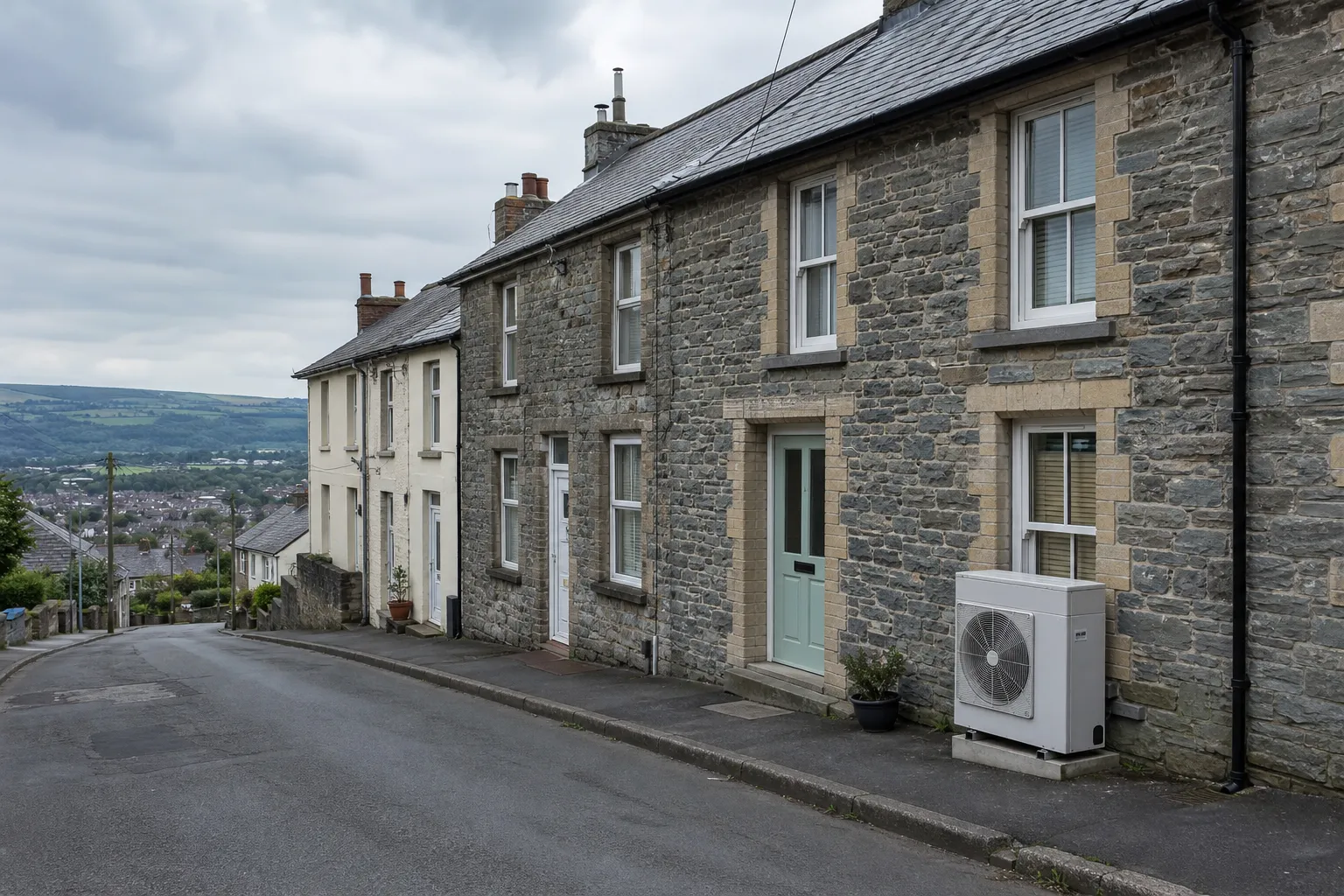
Partly true. A heat pump is not silent. The outdoor unit hums, gets louder when working hard in very cold weather and makes a brief noise during defrost. Most of the time, a well-placed modern unit is quiet enough that you hear little from a few metres away. Problems usually come from poor positioning: a bracket on a bedroom wall, a cramped corner that bounces sound, or a unit facing a neighbour’s window. See our noise and planning guide.
“You need underfloor heating”
False. Underfloor heating suits heat pumps well, because a large warm floor works nicely with low water temperatures. But it is not required. Most UK installations use radiators, with a few upsized where rooms lose the most heat. Our radiators guide covers what changes.
“You must insulate the whole house first”
Partly true. You do not need to insulate every wall before a heat pump will work, and the Boiler Upgrade Scheme has no insulation requirement. But basic insulation, such as a topped-up loft and draught proofing, still helps. It lowers heat loss, which can mean a smaller unit, fewer new radiators and lower bills. Do the cheap jobs first. You rarely need expensive solid wall insulation before anything else.
“Heat pumps cost more to run than gas”
Partly true. It depends on the efficiency of the system, the price of electricity compared with gas, and the tariff you choose. A heat pump’s efficiency is measured as a COP, the units of heat delivered for each unit of electricity used. Because electricity costs more per unit than gas, a heat pump needs a good COP to match a gas boiler on running costs. A well-designed system in a reasonable home often does, especially on a tariff built for heat pumps. A poorly designed system running at high temperatures in a draughty house can cost more. Our running costs guide shows how to compare them.
Switching from oil or LPG usually makes the running cost case stronger than switching from mains gas.
“Heat pumps do not work in old houses”
False, with conditions. Plenty of Victorian and 1930s homes run heat pumps well. Older houses usually need more careful design, a larger unit and more radiator changes. A very draughty house with no plan to improve it may be better off with a boiler for now. See are heat pumps right for older houses.
“The radiators will never feel hot”
True, and that is fine. Heat pump radiators feel warm rather than hot, because the water is cooler. The system runs for longer at a steady temperature instead of short hot bursts. Rooms stay comfortable if the radiators are sized properly. It takes some getting used to.
“Heat pumps cannot give enough hot water”
False, with a trade-off. A heat pump heats a stored cylinder of hot water. Sized correctly, it handles showers and baths for a typical family. The trade-off is that, unlike a combi, the supply is not unlimited: once the cylinder is used up, it takes time to reheat. You also need space for the cylinder.
Myths about cost and grants
Two more come up often. “Heat pumps cost £20,000” is usually wrong for an air source system: a typical installation costs £11,000 to £14,500 before any grant, and £3,500 to £7,000 after the £7,500 Boiler Upgrade Scheme grant in England and Wales (typical, checked October 2026). Ground source systems do cost more. “The grant is only for low-income homes” is also wrong: the Boiler Upgrade Scheme is not means-tested, though you need a valid EPC and must be replacing fossil-fuel heating. Scotland and Northern Ireland have different arrangements, so check the current rules for where you live.
Our view
A heat pump is the right choice for many homes and the wrong one for some. If your house is very hard to heat, your budget is tight, or you need heating this week, a modern boiler can still be the sensible call; see our boiler replacement hub. City Boiler is not an installer. We connect you with independent MCS-certified installers who survey properly and give you a straight answer for your house.
Common questions
Do heat pumps work when it is below freezing?
Yes. Air source heat pumps are designed to keep working well below freezing and are widely used in countries much colder than the UK. Their efficiency drops as it gets colder, which is why sizing for your local design temperature matters.
Are heat pumps more expensive to run than gas boilers?
It depends on the house, the design and your electricity tariff. A well-designed system in a reasonably insulated home can cost about the same as gas or less, especially on a heat pump tariff. A poorly designed one in a leaky house can cost more.
Do heat pumps need underfloor heating?
No. Most UK heat pumps run on radiators. Some radiators may need to be bigger. Underfloor heating works well with a heat pump, but you do not need it.
Do I have to insulate my house before getting a heat pump?
There is no insulation requirement for the Boiler Upgrade Scheme in England and Wales. Insulation still helps, because it lowers heat loss and can mean a smaller heat pump and fewer radiator changes.