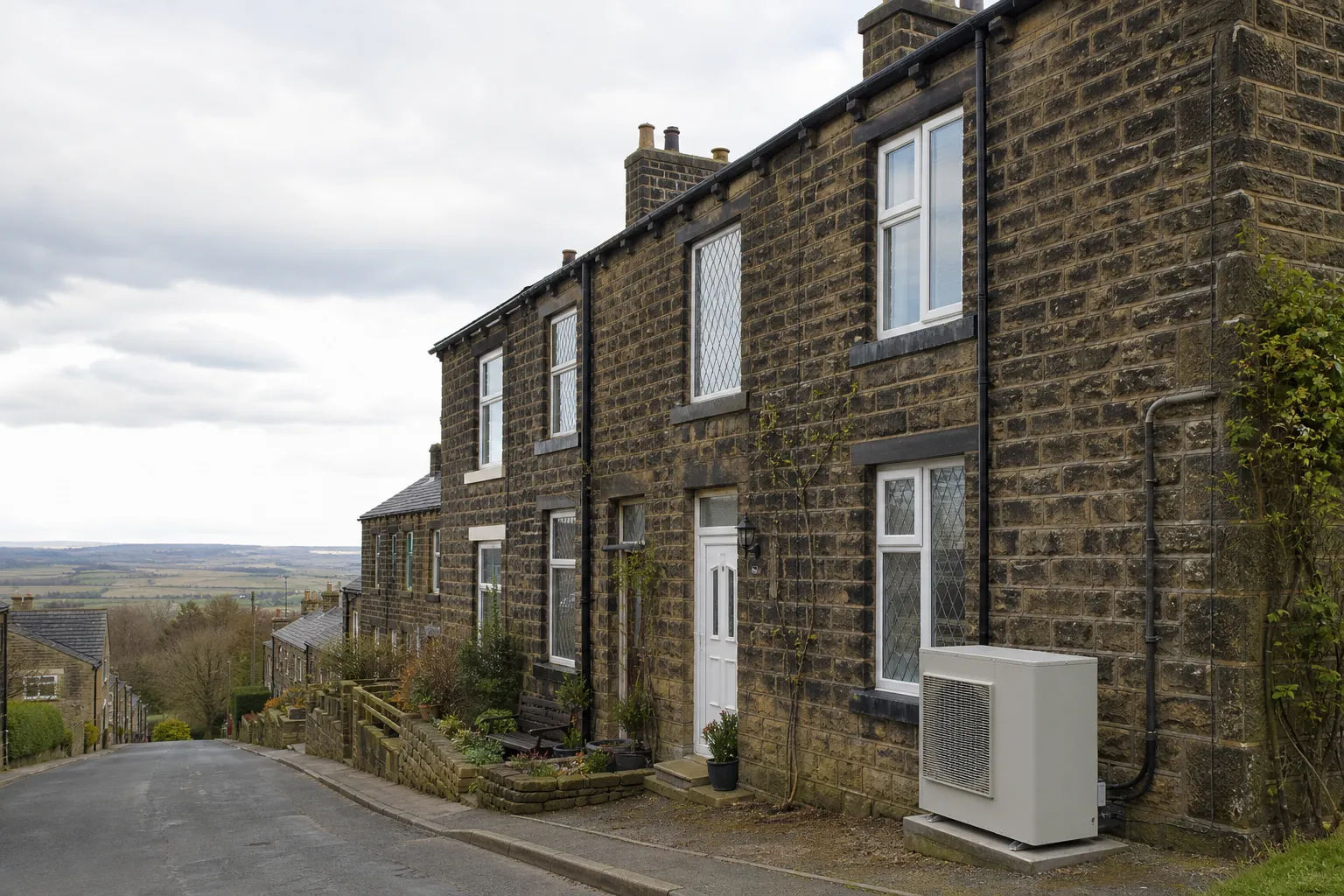
The honest answer
Yes, a heat pump can work well in an older house, and plenty of Victorian terraces, Edwardian semis and 1930s homes run on them. Age is not the deciding factor. What matters is how fast the house loses heat, whether the radiators are large enough to heat each room at a lower water temperature, and whether the system is designed properly. An old house with a loft full of insulation and decent windows can suit a heat pump better than a leaky 1970s build. A cold, damp, draughty house with tiny radiators and no plan to improve it is a different story. There, a new boiler may be the better call for now.
Why older houses worry people
A gas boiler heats radiator water to around 60 to 70°C. A heat pump works most efficiently at lower flow temperatures, often 35 to 50°C. Flow temperature is simply how hot the water is when it leaves the heat source. Lower temperature water gives off heat more gently, so radiators sized for a boiler can struggle to warm a room that leaks heat quickly.
Older houses tend to lose heat faster because of:
- Solid brick or stone walls rather than insulated cavities.
- Suspended timber floors with draughts coming up through the boards.
- Single glazing or tired sash windows.
- High ceilings and larger room volumes.
- Open chimneys pulling warm air out.
None of these is a deal breaker on its own. Together, without any improvement, they can make a heat pump expensive to run.
What to check in your house
| Feature | Good sign | Needs attention |
|---|---|---|
| Loft | 270mm of insulation | Little or none |
| Walls | Cavity filled, or internal insulation in some rooms | Solid walls, no insulation |
| Windows | Double glazed, or sashes with secondary glazing | Single glazed and draughty |
| Floors | Insulated or carpeted with sealed gaps | Bare boards with visible gaps |
| Chimneys | Blocked or fitted with a balloon or cap | Open and unused |
| Radiators | Large, double panel | Small single panel in big rooms |
If most of your answers sit in the right-hand column, you are not ruled out, but expect a larger heat pump, more radiator changes and higher running costs unless you fix some of them first.
What to do first, in order of value
- Loft insulation. Cheap and usually quick to fit. Often the biggest single win.
- Draught proofing. Seal floorboards, skirting gaps, letterboxes and unused chimneys.
- Windows. Secondary glazing is a lower-cost option for sash windows and is often acceptable in conservation areas.
- Radiators. Swap the smallest radiators in the coldest rooms. Typical cost is £300 to £600 each, fitted (checked October 2026). See our guide to radiators for heat pumps.
- Wall insulation. Internal or external solid wall insulation helps most but costs most. It is rarely the first step.
You do not need to do everything. The point is to know what the house needs before you size the heat pump, because each improvement can make the unit smaller and the bills lower.
Sizing is where older homes go wrong
Older houses vary more than new ones, so guesswork fails more often. A proper installer will carry out a room by room heat loss calculation, using the construction of each wall, floor and window, and size the heat pump and radiators to match. Rules of thumb based on floor area or the old boiler’s output are particularly unreliable in period homes. Our guide on what size heat pump you need explains why.
If an installer quotes for a heat pump in an older house without measuring every room, ask why. That calculation is the difference between a warm home and a cold one.
Listed buildings and conservation areas
Many older homes sit in conservation areas, and some are listed. The outdoor unit may need planning permission or listed building consent, and you may be limited on where it goes. Check before you design the system around a particular wall. Our noise and planning guide covers the general rules.
When a boiler is the better call
We will tell you straight when a heat pump is the wrong fit. That is usually when:
- The house is very hard to insulate and you have no plans to improve it.
- Most radiators would need changing and there is no budget for it.
- You need heating restored this week and cannot wait for a design.
- You plan to move in the next few years.
In those cases, a modern condensing boiler is often cheaper to install and less risky. You can compare prices at our boiler replacement hub. A hybrid system, a small heat pump working alongside a boiler, is another middle route; see our hybrid heat pump guide.
Costs and grants
A typical air source heat pump costs £11,000 to £14,500 before any grant. In England and Wales, the Boiler Upgrade Scheme takes £7,500 off, bringing a typical job to £3,500 to £7,000 (typical, checked October 2026). Older homes more often sit at the upper end, because of larger units and more radiator work. The grant has no insulation requirement, but you need a valid EPC. Check the current rules before you commit.
City Boiler is not an installer. We connect you with independent, MCS-certified installers who survey your house properly and give you a fixed price.
Common questions
Will a heat pump work in a Victorian house?
Often, yes, if the system is designed around the house's real heat loss. Solid walls lose more heat than cavity walls, so the heat pump may need to be larger and some radiators bigger. A room by room heat loss calculation tells you whether it is a sensible fit.
Do I need solid wall insulation before fitting a heat pump?
Not always. Solid wall insulation is expensive and can be disruptive, and many older homes run heat pumps without it. Cheaper fixes such as loft insulation, draught proofing and secondary glazing usually come first.
Can I get the Boiler Upgrade Scheme grant on an old house?
Yes. In England and Wales the £7,500 grant has no insulation requirement and no age limit on the property. You need a valid EPC and you must be replacing fossil-fuel heating such as gas, oil or LPG.
Is a heat pump allowed on a listed building?
It can be, but you will usually need listed building consent, and permitted development rights may not apply. Speak to your council's conservation officer before you commit to a position for the outdoor unit.